


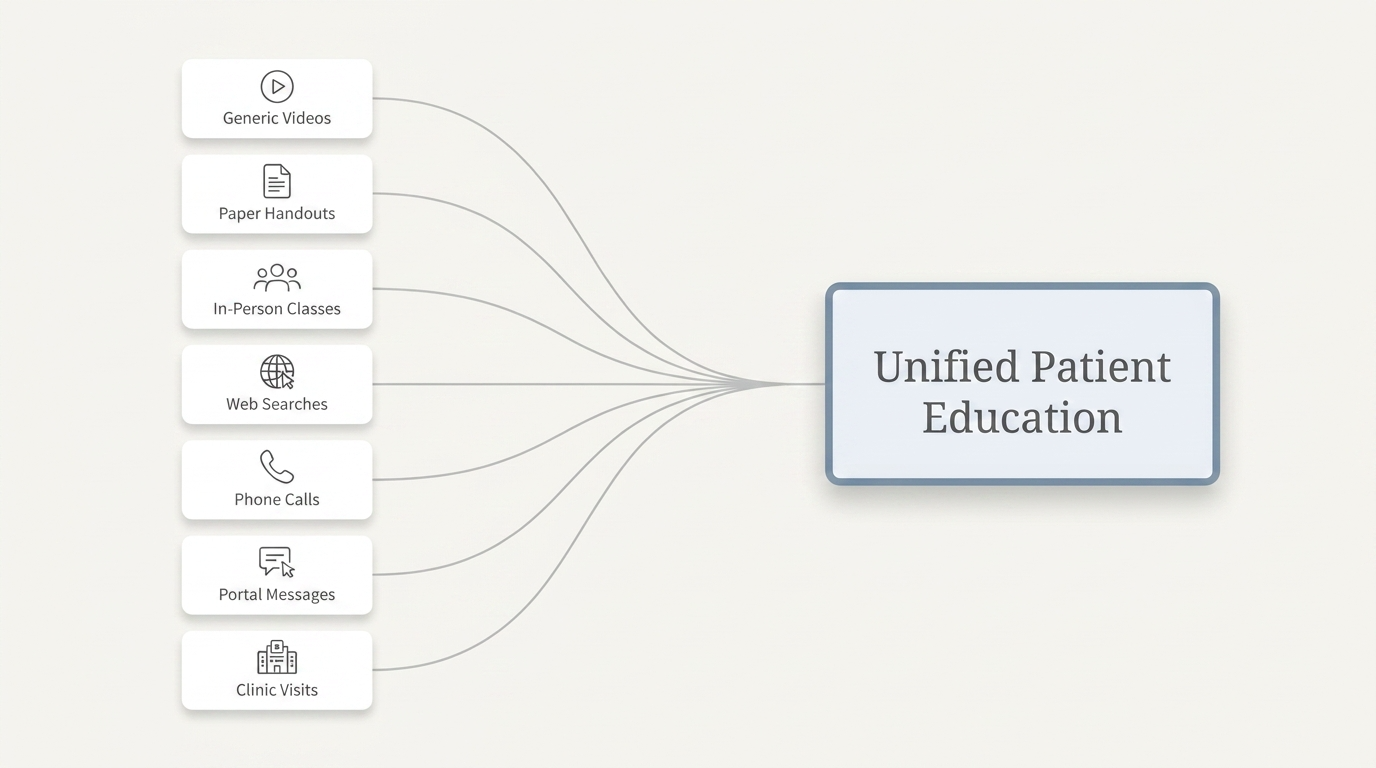

Pre-procedural education is one of the highest-leverage moments in orthopedic care — the point where a patient's expectations, preparation, and confidence are set before they ever reach the operating room. Yet in most practices it is inconsistent, hard for patients to absorb, and treated as a compliance box to check rather than a clinical intervention. Despite good intentions, the way education is delivered today routinely fails both patients and the teams caring for them.
How education is commonly delivered today
Hardcopy handouts. Most patients receive multi-page instruction packets before surgery, in clinic, or electronically. Many never read them fully, and even those who do retain little — anxiety, unfamiliar terminology, and sheer information overload all work against comprehension.
One-on-one education in clinic. Education is delivered by a range of staff and providers, both proactively during visits and reactively through phone calls and portal messages. Content varies widely, the time burden is substantial, and patient recall after a visit is often limited.
In-person preoperative classes. “Joint camps” are common but poorly attended. Built to serve multiple surgeons at once, they struggle to address surgeon- or facility-specific protocols, and travel, scheduling, and caregiver availability further limit their reach.
Generic videos. Videos on websites or platforms like YouTube describe what generally happens during a procedure but rarely reflect a specific surgeon's protocols, facility policies, or care pathways. Locally produced videos tend to go stale as protocols and personnel change.
Patient-driven internet searches. When education is incomplete, patients fill the gaps themselves — through internet or AI-based searches that rarely offer surgeon- or facility-specific guidance and frequently surface conflicting or inaccurate information. The process of correcting misinformation adds anxiety for patients and work for caregivers.
This is not a new problem: what the research shows
The research is consistent on one point: failures in pre-procedural education are systemic, not individual.
Time constraints and a lack of organizational support are repeatedly identified as the primary barriers to effective education, resulting in fragmented and inconsistent delivery. Content varies significantly depending on who delivers it, leaving patients unevenly prepared even within the same practice. Poor interdisciplinary coordination is well documented, with medical information duplicated while psychosocial and recovery-related education falls through the cracks.
Comprehension and retention are limited under the best of circumstances, contributing to missed instructions, nonadherence, and even day-of-surgery cancellations. Cultural and communication barriers compound the problem: language differences, lower health literacy, and differing expectations all shape understanding and informed consent — and poorly tailored education has been shown to raise anxiety rather than lower it, underscoring the risk of one-size-fits-all approaches. Standardized material that ignores procedure type, prior experience, and individual circumstances consistently falls short of what patients need.
The core problem
Each traditional approach delivers a fragment of information, but none provides a unified, reliable, and personalized pathway. Education today is episodic rather than longitudinal, generic rather than specific, and disconnected from how care is actually delivered. Patients are left to form their own understanding of surgery — and often do so incorrectly.
The problem isn't a lack of patient education—it's a lack of connected patient education. Replacing fragmented information with one unified pathway benefits both patients and care teams.
A different approach
Solving this doesn't call for another handout or a slicker video. It calls for treating education as a single, connected pathway rather than a stack of disconnected artifacts — one that follows the patient across the full episode and reflects the exact care they will receive.
OrthoSkool was built in response to these systemic failures: not another educational artifact, but a unifying educational platform. It is designed to consolidate the handouts, in-person classes, generic videos, and patient-driven searches into a single, coherent experience, while augmenting — not replacing — the one-on-one education that occurs in clinic. By handling predictable, repetitive instruction up front, it aims to shorten time in clinic, reduce phone calls and portal messages, and let clinical conversations focus on higher-value decision-making.
Why this matters
If we continue educating patients as we do today, we will keep handing them fragmented, incomplete, or inaccurate information before surgery. Providers and staff will continue to spend excessive time in clinic, on the phone, and in the portal. And we will keep missing one of the few pre-surgical interventions capable of improving patient experience, satisfaction, and outcomes — while quietly adding to the total cost of care.
Pre-procedural education should not be a checkbox.
It should be treated as clinical infrastructure.
Sources
Abbass, R., et al. (2020). Effectiveness of preoperative patient education on adherence and perioperative outcomes. Journal of Perioperative Practice.
Ankuda, C. K., et al. (2014). Language barriers, education level, and informed consent in surgical patients. Journal of Surgical Research.
Brodersen, F., et al. (2023). Variability in content and delivery of preoperative patient education programs. Patient Education and Counseling.
Deyirmenjian, M., et al. (2006). Cultural influences on preoperative education and patient anxiety. Journal of Advanced Nursing.
Fitzpatrick, E. M., et al. (2006). Nurses' interpretations and practices of preoperative patient education. Journal of Clinical Nursing.
Furtado, R., et al. (2022). Adherence and fidelity in patient education interventions: A systematic review. BMC Health Services Research.
Koivisto, J.-M., et al. (2020). Patient perceptions of adequacy of preoperative education across demographic groups. Journal of Nursing Care Quality.
Kruzik, N. (2009). Challenges in implementing formal preoperative teaching in ambulatory surgery settings. AORN Journal.
Lee, A., et al. (2005). Patient misconceptions and unmet informational needs prior to surgery. Journal of Advanced Nursing.
Lee, C.-K., et al. (2013). Barriers affecting nurses' provision of preoperative teaching. Journal of Clinical Nursing.
Stern, C., et al. (2005). Effectiveness of preoperative education on patient knowledge and skill performance. International Journal of Nursing Studies.
Tse, K., et al. (2008). Obstacles to preoperative education in ambulatory surgery nursing practice. Journal of PeriAnesthesia Nursing.
van Weert, J. V., et al. (2003). Information exchange gaps in multidisciplinary preoperative consultations. Patient Education and Counseling.
Yilmaz, U., et al. (2019). Evaluation of nurses' preoperative patient education practices. Journal of PeriAnesthesia Nursing.
