



Two weeks ago, my colleague Jesse Chrastil, MD, published a thought-provoking LinkedIn post titled “Your Water Heater Is Valued More Than Your New Knee.” Behind the provocative title was a serious warning: Medicare’s declining reimbursement for joint replacement increasingly fails to reflect the expertise, responsibility, and work involved in caring for these patients—and could ultimately threaten access to care. [1]
On November 4, CMS finalized the 2027 Physician Fee Schedule. Beginning January 1, Medicare’s national professional payment for a primary total knee replacement will fall to $953, and for a total hip replacement to $955. For most surgeons, that is a reduction of nearly 18% from 2026, after a more than 7% cut the previous year. These payments go to the physician practice and cover the operation and routine postoperative care throughout the 90-day global period. Advocacy by AAHKS, AAOS, and others softened the original proposal, but the reductions remain substantial. [2, 3]
The next day, the AAHKS Annual Meeting opened in Grapevine, Texas. In a symposium presentation titled “How Did We Get Here? A History of THA and TKA Valuation,” Michael Bolognesi, MD, described the moment in five words: “We are at a crossroads.” [4]
Throughout the meeting, the same themes surfaced repeatedly. Surgeon reimbursement continues to decline, practice costs continue to rise, and maintaining revenue increasingly depends on surgical volume. Yet much of the work involved in caring for joint replacement patients remains essential, even when traditional payment models make it less visible.
What the final rule means for surgeons
CMS lowered the physician work relative value units (wRVUs) for primary hip and knee replacement from 19.11 to 16.70, a 12.6% reduction. For knee replacement, the practice expense component fell from 11.58 to 9.05 RVUs (21.9%), and malpractice RVUs also declined. The standard Medicare conversion factor fell about 2.3% as a temporary 2026 payment increase expired. Together, these changes reduce the national professional payment for primary hip and knee replacement by nearly 18% in 2027. [5, 2]
The final rule also addressed surgeons’ central argument. CMS agreed that moving these procedures to outpatient settings has not necessarily reduced the work involved, but rejected the idea that doing the same work in less time makes the work more intense. CMS ultimately adopted the RUC-recommended value, citing concerns about patient access, while stating that it remains concerned about the accuracy of these values. [2]
How we got here
This isn’t the first revaluation of joint replacement, and the long-term trend is hard to ignore.
A 2013 review reduced the physician work value of primary knee replacement by about 16% and hip replacement by 10%. The 2026 efficiency adjustment reduced those values again, followed by the 2027 cuts. Compared with the values before that earlier review, the work RVU assigned to primary knee replacement has declined by about 28%. [4]
The reduction in actual purchasing power is considerably greater.
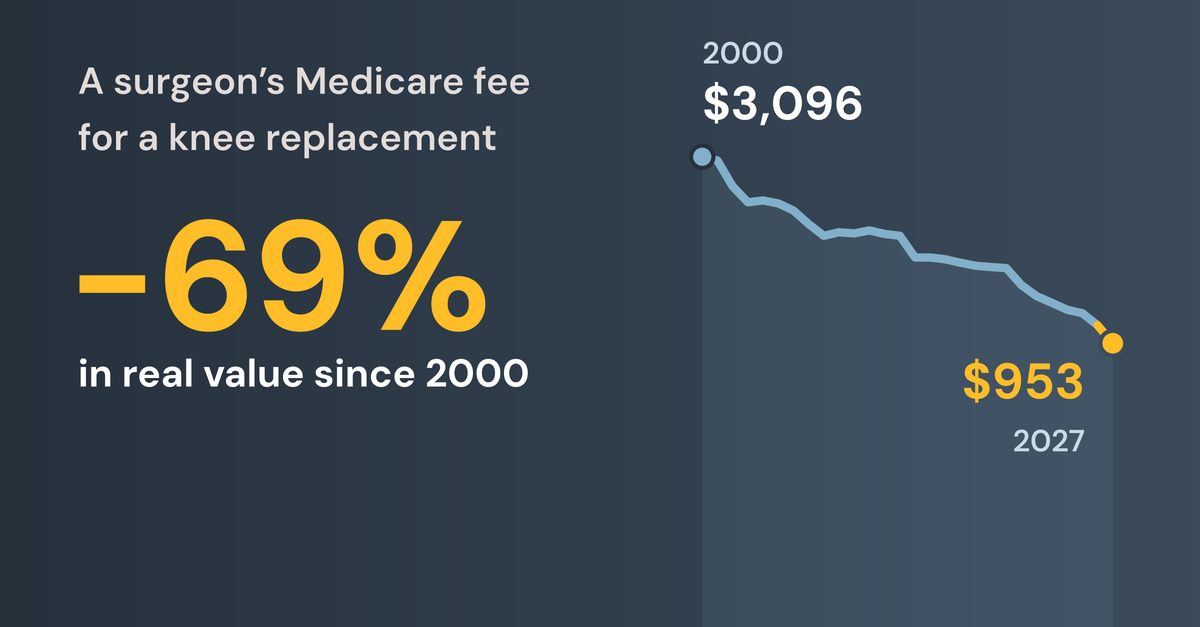
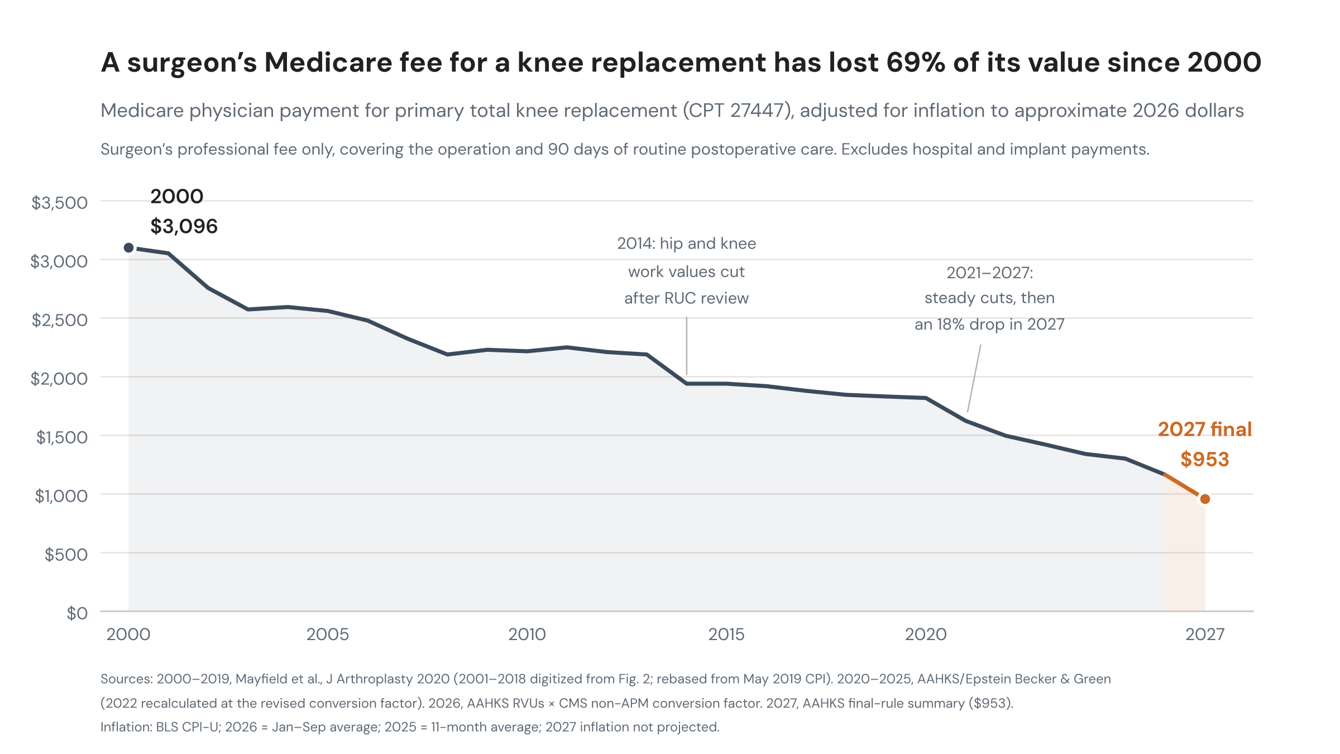
In 2020, Medicare’s national professional payment for primary knee replacement was approximately $1,413. In 2027, it will be $953—about one-third less in nominal terms. Using historical values published by Mayfield and colleagues and subsequent fee schedules, the estimated inflation-adjusted decline since 2000 approaches 69%. [6, 7, 2]
Most patients understand little about what surgeons are actually paid. A systematic review of 12 studies involving more than 4,300 patient surveys found that patients estimated Medicare reimbursement to orthopedic surgeons at nearly six times the actual amount. They believed a reasonable payment would be more than 11 times what Medicare pays. [8]
Shorter stays, same work
The revaluation reflects the shift toward outpatient joint replacement. As hospital stays have shortened, inpatient visits historically included in the 90-day global package often no longer occur, and measured procedure times have fallen. CMS has also questioned whether the postoperative visits assumed in global surgical payments reflect contemporary practice. [5, 2]
At AAHKS, speakers argued that shorter stays have not reduced the overall work of caring for these patients; much of it has moved before surgery and after discharge. They highlighted the substantial responsibilities associated with patient selection, preoperative optimization, education, discharge planning, and postoperative coordination.
Some of that work is quantifiable. One study of nearly 7,000 hip and knee replacement patients documented more than 47,000 perioperative telephone calls—more than seven per knee replacement patient before and after surgery. None of it shows up in the length of a hospital stay. [9]
Outpatient joint replacement has eliminated some inpatient work, but also shifted responsibilities into the weeks before surgery and the days after discharge. Important work may occur in the clinic, through telephone calls and portal messages, and across the care team—activities that are not captured by hospital length of stay.
I have personally championed outpatient arthroplasty and developed training materials for two large healthcare organizations. A central message we taught staff was that less time with patients in the facility requires more—not less—patient education, along with greater attention to patients before surgery and after discharge. Same-day discharge can be safe and effective, but it requires deliberate preparation, coordination, and access to support when questions or problems arise.
Surgeons and their teams created the clinical pathways that made these efficiencies possible. It would be a mistake to count the inpatient work that disappeared while overlooking the work necessary to make shorter stays successful.
The volume treadmill
As per-case payment declines, most surgeons I know have historically responded by increasing surgical volume. But that strategy has limits.
Researchers from Cleveland Clinic presented a poster at AAHKS testing that approach. Among primary-focused arthroplasty surgeons studied from 2013 to 2023, 71% saw their inflation-adjusted Medicare income decline, and median real payment per case fell 33.8%. For those whose income declined, the median surgeon would have needed approximately 47 additional cases annually to restore their earlier income, yet those surgeons added a median of only three cases over the decade. The researchers projected that the gap would keep growing. [10]
Every additional operation brings another patient who must be evaluated, educated, optimized, and supported through recovery. A surgeon who needs 47 more cases also needs a practice that can support 47 more patients through the entire surgical episode—along with the clinical time, staff, and infrastructure that it requires.
Surgeons can’t keep doing more just to earn the same. Capacity has a ceiling.
The financial squeeze on practices—and the consequences for patients
While Medicare reimbursement for joint replacement continues to decline, the costs of running an orthopedic practice—including staffing, facilities, malpractice coverage, technology, and regulatory compliance—keep rising.
The American Alliance of Orthopaedic Executives (AAOE) reports that average orthopedic practice overhead increased from 58.5% of net patient revenue in 2020 to 65.3% in 2024. Over the same period, average cost per patient visit rose from $226 to $269, while staff costs increased from 31% to 36.6% of revenue. These are practice-wide benchmarks, not costs specific to joint replacement. [11]
The final rule adds pressure on the office side of the same practices. Beginning in 2027, when a surgeon performs a procedure with a 0-day global period, such as a joint injection, on the same day as a separately identifiable office visit billed with Modifier 25, the lower-valued of the two services will be paid at 80%. Joint replacement itself is exempt, but same-day injections are routine in most orthopedic practices. [5]
These pressures have broader implications. According to the AMA, the proportion of U.S. physicians in private practice declined from 60.1% in 2012 to 42.2% in 2024. AAHKS warns that further reimbursement cuts could accelerate practice consolidation and threaten patient access, particularly in rural communities. [12, 3]
Several surgeons I spoke with at AAHKS were considering opting out of Medicare. Some who had already done so described performing fewer operations, spending more time with patients, and maintaining or increasing their income. It’s difficult to fault physicians for seeking compensation they believe reflects the value of their expertise and responsibility.
But surgeons don’t have to leave Medicare for access to worsen. Participating practices are not required to accept new Medicare patients, and as reimbursement falls, the financial pressure to limit Medicare volume grows. If more surgeons opt out or limit the Medicare patients they accept, beneficiaries could face fewer choices, longer waits, and reduced access to specialized care. For patients who paid into Medicare throughout their working lives, only to find their access to care increasingly limited in retirement, that would represent a profound failure of the system. [13]
What organizations can control
Individual surgeons and healthcare organizations cannot determine Medicare payment policy. Advocacy remains essential, but practices must also examine how perioperative care is designed and delivered.
If reimbursement continues to decline while clinical responsibilities remain substantial, practices must look beyond increasing volume.
The relevant question is not simply how many minutes a surgeon spends in the operating room, but how the entire clinical team uses its time before, during, and after surgery. Which activities require professional judgment? Which predictable tasks can be standardized without compromising patient care?
The goal should not be less care. It should be better use of the limited time clinicians and staff have to deliver it.
How OrthoSkool can help
If practices are asked to deliver complex care with fewer resources, simply adding cases, shortening visits, or hiring more staff isn’t always sustainable. One practical opportunity is to deliver essential, repeatable patient education more consistently and efficiently.
Surgeons, APPs, nurses, and staff repeatedly answer the same questions about preparation, medications, wound care, activity, and recovery during visits, phone calls, and portal messages. These explanations matter, but much of their content is predictable. Clinicians’ time is better reserved for individualized concerns and decisions that require their expertise.
OrthoSkool’s surgeon-developed, evidence-based online courses are tailored to each organization’s protocols and facilities. Patients can complete and revisit the material on their own time, and clinical teams can monitor completion. By providing consistent answers proactively, OrthoSkool aims to improve preparation, reduce repetitive education, and reclaim clinical time—not replace meaningful patient-clinician conversations.
More efficient patient education cannot correct an inadequate reimbursement model. It can, however, help preserve clinical capacity and the time clinicians need for individualized care.
The road ahead
The concern is not simply one more reduction. New cuts are being applied to services whose reimbursement has already lost much of its value, while the cost of the people and infrastructure needed to deliver them continues to rise. CMS may reasonably question how physician time and intensity have changed, but lower measured work does not mean lower costs for providing safe, comprehensive care. [2, 11]
Surgeons and their teams have spent decades making joint replacement safer, more efficient, and less dependent on prolonged hospital stays. That success should not be mistaken for evidence that the episode of care has become less expensive to deliver. Sustaining it will require payment that recognizes the full scope of physician work and care models that use clinical time wisely. The question is whether we can preserve both the expertise and the capacity that exceptional joint replacement care requires.
References
1. Chrastil J. Your Water Heater Is Valued More Than Your New Knee. LinkedIn post. October 25, 2026.
2. Epstein Becker & Green for AAHKS. 2027 Physician Fee Schedule Final Rule: Executive Summary. November 4, 2026. https://www.aahks.org/wp-content/uploads/2026/11/2027-PFS-Final-Rule-Exec-Summary-11.4.26.pdf
3. American Association of Hip and Knee Surgeons. AAHKS Dismayed with CMS Cutting Hip and Knee Replacement Surgical Fee Payments, Warns of Threat to Patient Access [press release]. November 5, 2026. https://www.aahks.org/wp-content/uploads/2026/11/AAHKS_Press-Release_CMS-Final-Rule-Response_November-2026.pdf
4. Bolognesi M. How Did We Get Here? A History of THA and TKA Valuation. AAHKS Annual Meeting, Grapevine, TX. November 2026. Conference presentation.
5. Centers for Medicare & Medicaid Services. Calendar Year (CY) 2027 Medicare Physician Fee Schedule Final Rule (CMS-1848-F) [fact sheet]. November 4, 2026. https://www.cms.gov/newsroom/fact-sheets/calendar-year-cy-2027-medicare-physician-fee-schedule-final-rule
6. Epstein Becker & Green for AAHKS. National Average Medicare Payment Trends for Hip and Knee Surgeries, 2020–2026. December 2025. https://www.aahks.org/wp-content/uploads/2026/01/National-Average-Medicare-Payment-Trends-for-TJA-2020-2026.pdf
7. Mayfield CK, Haglin JM, Levine BR, et al. Medicare Reimbursement for Hip and Knee Arthroplasty From 2000 to 2019: An Unsustainable Trend. J Arthroplasty. 2020;35:1174–1178. https://doi.org/10.1016/j.arth.2019.12.008
8. Boudreau SC, Dombrowsky AR, Arguello AM, et al. Patient Perception of Orthopedic Surgeon Reimbursement. South Med J. 2020;113(4):191–197. https://pubmed.ncbi.nlm.nih.gov/32239232/
9. Kheir MM, Rondon AJ, Bonaddio V, et al. Perioperative Telephone Encounters Should Be Included in the Relative Value Scale Update Committee Review of Time Spent on Total Hip and Knee Arthroplasty. J Arthroplasty. 2019;34(8):1563–1569. https://www.sciencedirect.com/science/article/abs/pii/S088354031930467X
10. Emara AK, Dinesh A, Elmenawi KA, et al. Primary Arthroplasty Surgeons May Require 163 More Annual Cases by 2040 to Offset Medicare Cuts. Poster, AAHKS Annual Meeting. November 2026. Conference findings; poster data not independently audited.
11. Sprague V. Leveraging Benchmarking Data for Success in Orthopedic Practices. American Alliance of Orthopaedic Executives white paper (data year 2024). https://assets.noviams.com/novi-file-uploads/aaoe/Leveraging_Benchmarking_Data_Whitepaper.pdf
12. American Medical Association. Smaller share of doctors in private practice than ever before. June 24, 2025. https://www.ama-assn.org/practice-management/private-practices/smaller-share-doctors-private-practice-ever
13. American Medical Association. Know Your Options: Medicare Participation Guide. https://www.ama-assn.org/system/files/2019-05/know-options-medicare-participation-guide.pdf
