




For years, patient education has been viewed mainly through the lens of patient experience, informed consent, and satisfaction. Those goals still matter. But a changing reimbursement landscape is widening the conversation: how well a patient is prepared for surgery is becoming an operational and financial question as well.
On January 1, 2026, the Centers for Medicare & Medicaid Services (CMS) began the Transforming Episode Accountability Model (TEAM), a mandatory, five-year episode-based payment model that runs through 2030. More than 700 selected hospitals are now accountable for the cost and quality of a surgical episode from the operation through 30 days after discharge. For orthopedic programs, this is more than a reimbursement change. It reshapes how organizations think about preparing patients.
What Changed, and What is at Stake
TEAM covers five surgical episode categories: lower-extremity joint replacement, surgical hip and femur fracture treatment, spinal fusion, coronary artery bypass grafting, and major bowel procedures. Hospitals continue to receive traditional Medicare payments, but CMS later compares episode spending and quality performance with a risk-adjusted target price. Depending on the hospital's risk track and performance, reconciliation can result in an additional payment or money owed back to CMS.
Hospitals begin on a track without downside risk during the first performance year, but financial accountability increases as the model progresses. An early analysis by Brandeis University and the Institute for Accountable Care, based on 2023 Medicare claims, projected that up to two-thirds of participating hospitals could lose an average of about $1,350 per episode. This is a projection, not a TEAM result, but it illustrates the stakes. Success depends not only on the operation, but on how well the entire episode is managed.
The Episode Is Now the Unit of Economics
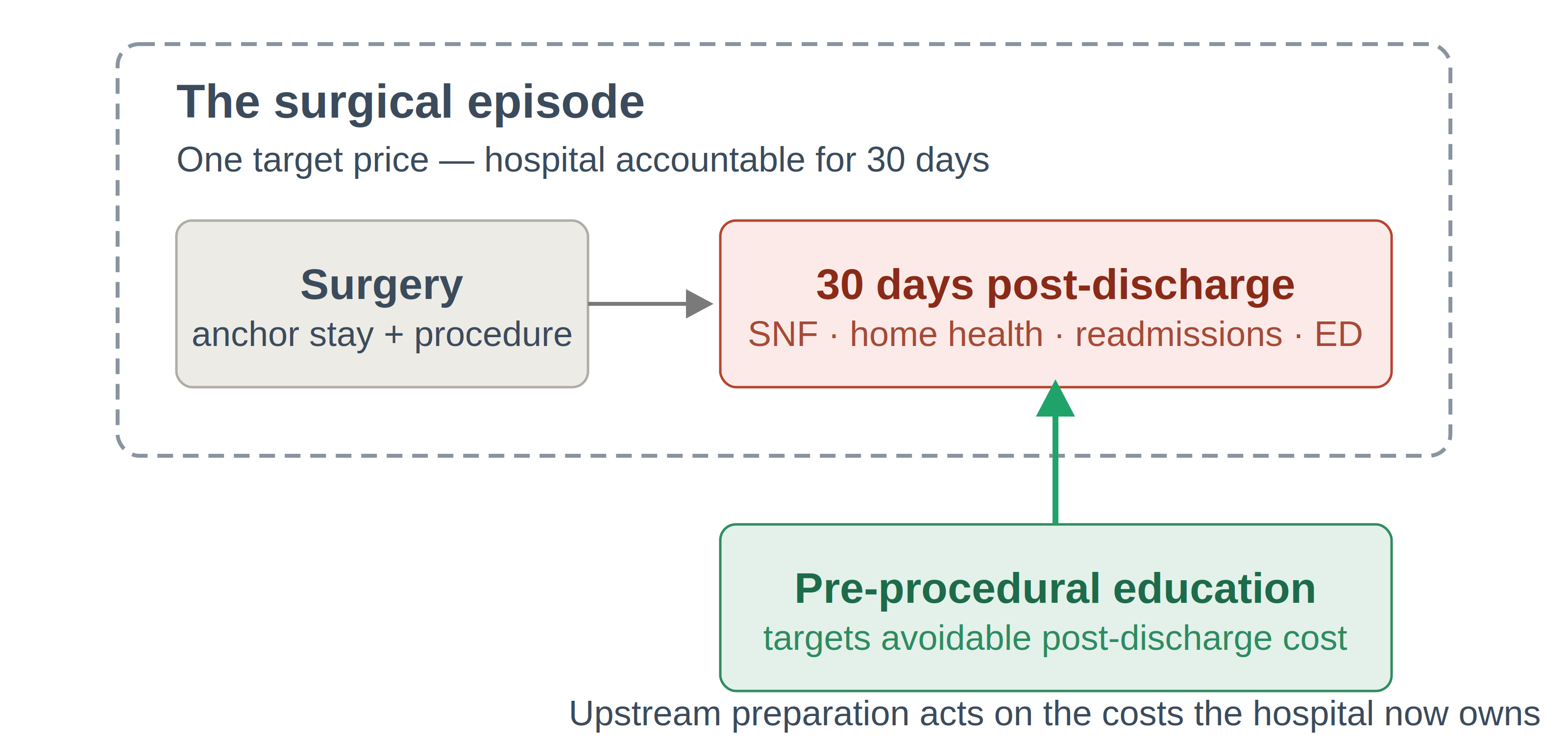
Under TEAM, a hospital's financial exposure extends beyond the operating room and the hospital stay. The 30-day episode includes post-acute care, rehabilitation, follow-up services, emergency department use, and readmissions. For joint replacement, some of the most expensive and variable parts of the episode occur after discharge.
Evidence from Medicare's earlier joint-replacement bundles shows why this matters. In the first two years of the Comprehensive Care for Joint Replacement model, spending declined modestly, driven largely by lower use of institutional post-acute care, without an increase in complications. The opportunity was not simply to reduce services; it was to help the right patients recover safely in lower-cost settings.
Where Patient Education Fits
Many factors that influence episode performance begin before the patient reaches the operating room. Effective preoperative education can address home preparation, skin cleansing, medication instructions, caregiver planning, realistic expectations for pain and mobility, rehabilitation, and warning signs. Education does not control these outcomes, but it can support the behaviors and decisions that make a safe discharge home, an appropriate response to symptoms, and an engaged recovery more likely.
Because these needs are remarkably consistent from one patient to the next, they are well suited to a standardized, protocol-aligned program. The strongest programs are intentional: they are designed around the patient's experience and recovery while also considering avoidable utilization and care-team workload. TEAM does not require hospitals to adopt a new education program, but it strengthens the case for scalable interventions that improve coordination and prepare patients to participate in their recovery.
Patient Readiness Becomes a Strategic Capability
The question is no longer only whether education improves satisfaction. It is whether patients are genuinely ready for surgery. Readiness goes beyond medical optimization. It includes understanding, practical preparation, realistic expectations, caregiver engagement, and the ability to participate in recovery. Under episode-based payment, patient readiness moves from a courtesy to a strategic capability.
Why This Matters
Patient education has often been discussed primarily as a patient-experience initiative. Under episode-based reimbursement, it also belongs in the conversation about discharge planning, post-acute coordination, complication prevention, avoidable utilization, and staff efficiency.
It is important to be clear-eyed about the evidence. Education is rarely delivered in isolation; it is usually one part of a broader perioperative pathway, making its independent effect difficult to isolate. Structured education alone will not determine TEAM performance. But it is relatively low-cost, low-risk, and scalable, and it can support several goals across the episode at once. That makes it more than a soft benefit. It is part of the infrastructure of coordinated, financially sustainable surgical care—and the role OrthoSkool was built to fill.
Sources
Centers for Medicare & Medicaid Services. Transforming Episode Accountability Model (TEAM). cms.gov/priorities/innovation/innovation-models/team-model (five-year mandatory model; 30-day episode; five episode categories; three risk tracks and a one-year glide path, with downside risk phasing in for most hospitals in 2027; quality measures and composite quality score; risk-adjusted regional target pricing).
Mechanic RE, Perloff J, Koppel D. Mandatory Medicare Bundled Payment and the Future of Hospital Reimbursement. American Journal of Managed Care. 2024;30(Spec No. 13):SP1050-SP1058 (Institute for Accountable Care and Brandeis University analysis: hospital counts and market coverage; projected per-episode gains and losses; post-acute care as a share of joint-replacement episode cost; quality adjustment).
American College of Surgeons. Transforming Episode Accountability Model. facs.org/advocacy (clinician summary of the Institute for Accountable Care analysis; up to two-thirds of hospitals projected to lose revenue).
Barnett ML, et al. Two-Year Evaluation of Mandatory Bundled Payments for Joint Replacement. New England Journal of Medicine, 2019 (episode savings driven largely by reduced discharge to post-acute care, without increased complications).
